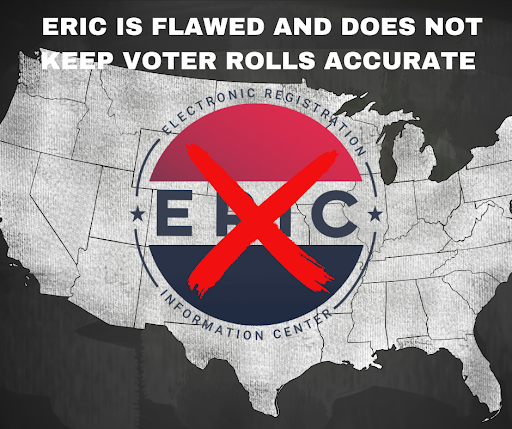
The Electronic Registration Information Center (ERIC) was created to improve the accuracy and efficiency of voter registration systems across the United States. Despite its good intentions, ERIC has proven to be a flawed system of helping to maintain voter accuracy.
ERIC operates independently of state and local election authorities which can make it difficult to hold the organization accountable for errors or failures in the accuracy of voter rolls.
One of the primary reasons for ERIC’s failure is its reliance on outdated and inaccurate data sources. ERIC relies heavily on data from state motor vehicle departments and other government agencies, which are often riddled with errors and inconsistencies. This has led to the inclusion of ineligible voters on the rolls and the purging of eligible voters from the registration lists.
This failure has been clearly demonstrated with the discovery of almost 1,400 deceased voters who are still on Maryland’s voter rolls. Compounding this issue is, due to these known failures, 14 states have fled the ERIC system since 2020. This has reduced the number of states who rely on ERIC to only 23 states leading to more inaccuracies in the data. For example, the majority of the 1,400 deceased records identified died in a state other than Maryland, many outside the ERIC system.
ERIC operates largely behind closed doors, with little oversight or public input. This lack of transparency has led to concerns about the integrity of the voter registration process and the potential for abuse or manipulation of the system.
ERIC has a one-size-fits-all approach to voter registration modernization. Each state has its own unique set of election laws and procedures, and ERIC’s standardized approach fails to consider the specific needs and requirements of individual states. This has led to a lack of flexibility and adaptability in the system, making it difficult for states to tailor their voter registration processes to their specific needs.
The implementation and maintenance of ERIC requires significant resources and funding.
The use of ERIC raises concerns about the privacy and security of voter information stored in the ERIC system, particularly given the potential for data breaches and unauthorized access to personal information
Finally, ERIC has been plagued by technical issues and glitches. These technical issues have ranged from simple software bugs to more serious security breaches that have compromised the personal information of voters.
In conclusion, ERIC has failed to live up to its promises of improving the accuracy and efficiency of voter registration and should be abandoned.