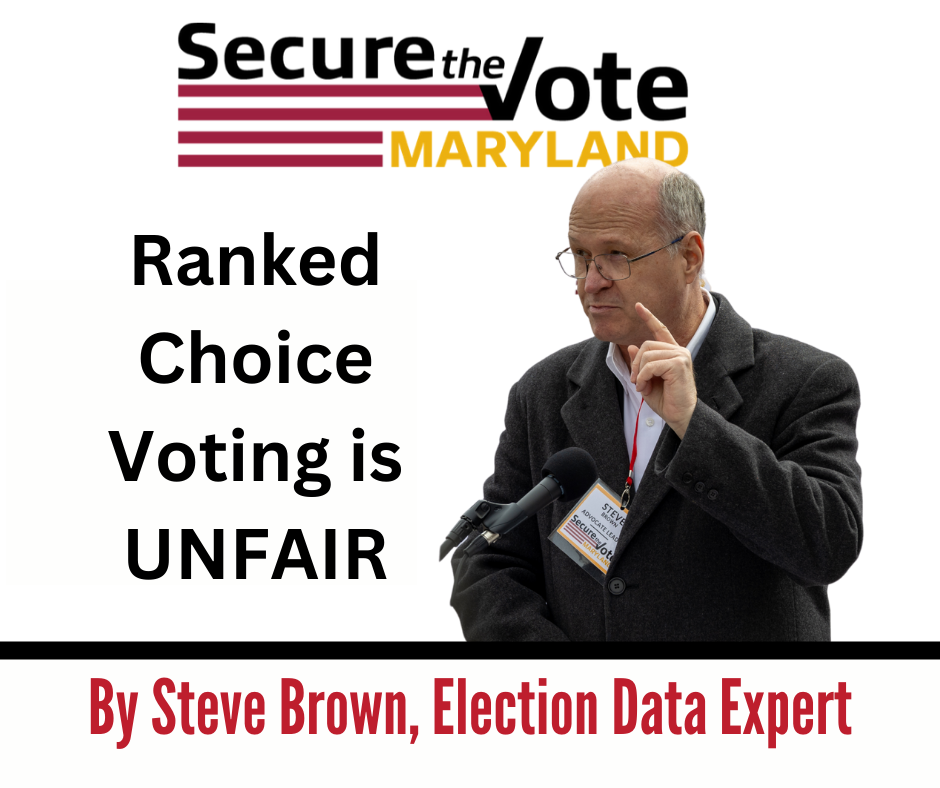
Ranked Choice Voting (RCV), also known as Instant Runoff Voting, is an alternative election system where voters rank candidates in order of preference rather than selecting just one candidate. If no candidate receives a majority of first-choice votes, the candidate with the fewest first-choice votes is eliminated. The eliminated candidate’s first-choice votes are then re- assigned to the next choice on each affected ballot. This process continues until a candidate achieves a majority. Proponents argue that RCV promotes majority support and reduces negative campaigning, but critics highlight several concerns about its impact on election integrity and voter participation.
What do all of us want or should want regarding elections? That they be Free, Fair, and Transparent or FFT. Ranked Choice Voting (RCV) does NOT promote FFT elections. Here are multiple reasons why:
1- One cannot Vote Against a Candidate
Voters must rank candidates for whom they may never, in their whole freaking life, consider casting a vote. By including a candidate in the ranking, one has voted for that candidate.
2- Extreme Candidates Can Win
Large vote disparities in the initial rounds can be overcome allowing candidates with little initial support to win. This can result in the election of candidates that a majority of voters do not or will never support.
3- Moderates Get Squeezed Out
RCV can favor polarizing candidates by dividing votes among more moderate options. As factions consolidate behind extreme choices, centrist candidates may struggle to survive the ranking process.
4- Ballot Exhaustion
If a voter does not rank every candidate, their ballot will be discarded in later rounds once all their ranked choices are eliminated. This is known as “ballot exhaustion” and effectively silences those voters, undermining the inclusivity of the election. So it is as if those voters never voted.
5- Lower Voter Participation
Measurement of voter participation in RCV elections has consistently shown that it lowers turnout, precisely the opposite effect desired in a democratically elected, represented society. In Minneapolis, St. Paul, and San Fransico, which have had ranked choice voting for a while, voter turnout has been consistently lower than in earlier elections without RCV.
6- Confusing to Voters
RCV is complicated and difficult to explain, thus reducing election transparency. This is against the principles of FFT elections referenced earlier. Confusion leads to voter disengagement, which contradicts the goal of an accessible and understandable voting process. Reports from Fairfax County, VA, which implemented RCV in 2022, were largely negative. Notably, ten states have already BANNED rank choice voting due to these concerns.
7- Increased Risk of Election Mismanagement and Fraud
The complexity of RCV means the election is more difficult to track and thus RCV creates opportunities for election mismanagement and fraud. RCV requires additional ballot:
-handling
-transportation
-chain of custody considerations and
-and adjudication
all which increase the likelihood of errors, security breaches and potential fraud.
8- Reporting Delays
RCV elections take significantly longer to determine a winner. Ballot exhaustion and multiple rounds of counting contribute to reporting delays. In New York City’s 2021 RCV election, it took nearly a month to declare a winner. Similarly, Alaska’s 2022 RCV election results took over two weeks to determine.
Conclusion
In summary, RCV increases election complexity, reduces transparency, increases the time to determine the outcome and diminishes voter confidence. In addition, RCV has a negative impact on voter participation and ultimately increases election costs.
(Shoutout to Captain Seth Keshel, whose original presentation of several years ago was drawn upon.)