On July 14, 2025, the U.S. Department of Justice (DOJ) issued a sweeping request for information to the Maryland State Board of Elections (SBE), invoking Section 20507(i) of the National Voter Registration Act (NVRA). The purpose was straightforward: determine whether Maryland’s voter rolls are being maintained in full compliance with federal law — and in doing so, provide the public with the transparency needed to maintain trust in our elections.
Sixteen days later, on July 30, 2025, the SBE issued its formal written response. What the DOJ asked for was neither radical nor unreasonable: names of the officials responsible, documentation of list maintenance processes, explanations for glaring discrepancies, and — critically — the data to prove that these processes work. Yet Maryland’s responses reveal a troubling pattern: process descriptions without proof, data gaps without deadlines, and opportunities for clarity left on the table.
Process Over Proof
In several cases, the State Board described how it maintains the rolls but offered no measurable results to demonstrate that these procedures are effective. For example, when asked how ineligible voters are removed, the SBE pointed to general practices but provided no statistics on actual removals. This approach turns transparency into a guessing game — the public is told there is a process, but cannot see whether it works.
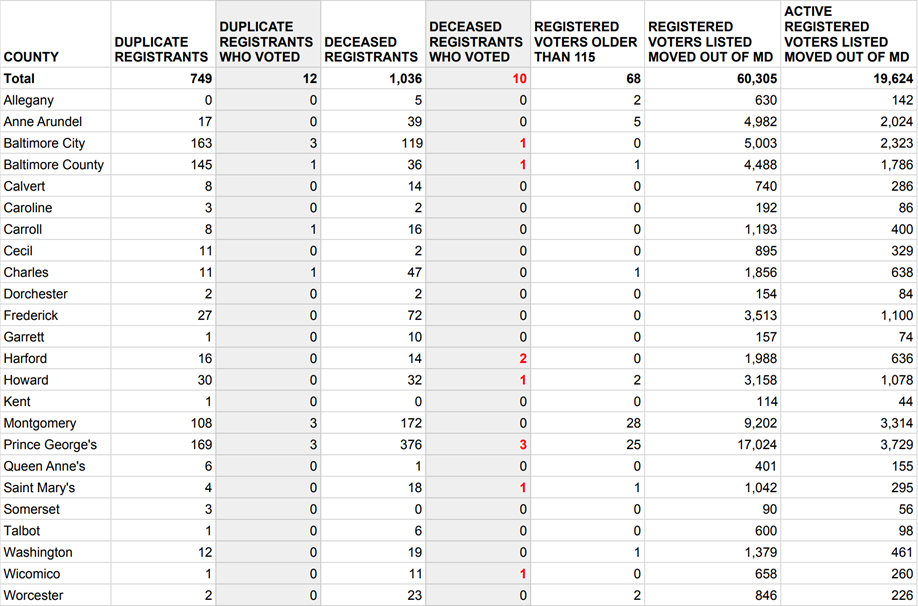
That lack of proof is especially troubling in light of independent data compiled by Secure the Vote Maryland (June 2025), which shows that duplicate registrations, deceased individuals, and voters who have moved out of state are still regularly found on Maryland’s rolls. In some counties, active registration even exceeds the eligible population, with totals surpassing 100% of voting-age U.S. citizens — far above the national average registration rate of 75.6%.
Secure the Vote Maryland Data Snapshot (June 2025) NVRA Violations:
Voter Roll Inflation:
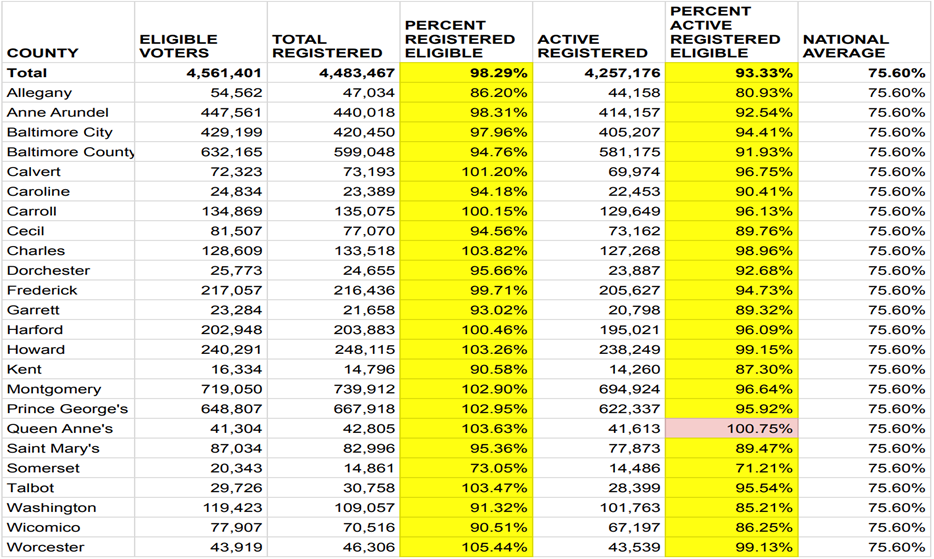
The evidence is clear: process alone is not proof. Without transparent performance metrics, verifiable removal statistics, and independent audits, Maryland voters cannot be assured that the SBE’s list maintenance obligations under the NVRA are being fulfilled.
Unanswered Questions, Unverified Numbers
The DOJ did an excellent job of identifying eight specific and well-documented discrepancies and concerns in the federally mandated Election Assistance Commission’s Election Administration and Voting Survey (EAVS) report, and requested clear answers to each. Instead of addressing these eight points individually — using the DOJ’s numbering, criteria, and requested information — the State Board of Elections largely sidestepped the questions. Rather than providing direct explanations or data, the SBE defaulted to general discussions of its internal processes, leaving the core issues unresolved.
Out of fifteen specific requests from the DOJ:
- Only three were fully answered.
- Four were partially addressed.
- Eight were left unanswered or without any data.
Among the most concerning omissions:
- No identification of the officials responsible for maintaining the rolls since 2022.
- No reconciliation for major statistical discrepancies in registration data.
- No explanation for why over 1.5 million confirmation notices were sent — or why such a small fraction resulted in removals.
- No data on non-citizens, adjudicated incompetents, or felons removed from the rolls.
- No counts of merged duplicate registrations, despite acknowledging there is no legislated process to verify them.
ERIC Reliance and Migration Blind Spots
Maryland acknowledges that its primary method of identifying duplicate and outdated registrations is through the Electronic Registration Information Center (ERIC). But ERIC has serious limitations. With less than half of U.S. states participating — and no legislated verification process or published performance metrics — Maryland voters are left to trust an opaque system without evidence of accuracy or timeliness.
This problem is magnified by migration patterns. Four of the top five states for out-of-state moves are not members of ERIC: Virginia, Florida, North Carolina, and Texas. Only Pennsylvania participates. That means the very states most likely to generate duplicate or outdated voter records for Maryland are not even part of the system Maryland relies on.
This is a prime example of how the State Board’s reliance on process, without proof, leaves major blind spots in ensuring clean and accurate voter rolls.
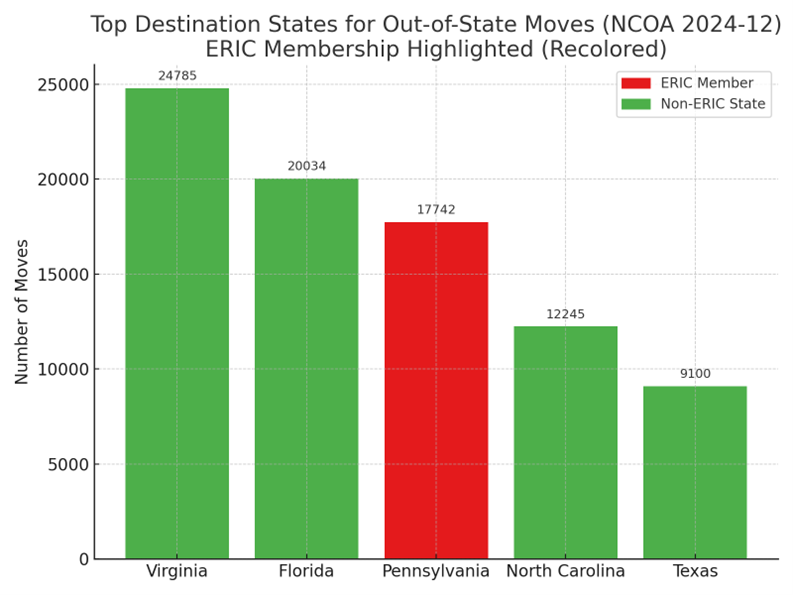
In the chart above, red bar shows ERIC members, while green bars show non-members. The imbalance illustrates why Maryland cannot depend solely on ERIC for duplicate detection.
Why This Matters
Election integrity depends not only on the accuracy of voter rolls but on the public’s confidence that those rolls are being managed competently, lawfully, and transparently. The DOJ’s request was an opportunity for Maryland to set a national example in openness and accountability. Instead, incomplete answers and missing data have only fueled skepticism.
Restoring Faith Through Transparency
The path forward is simple, answer the DOJ’s questions directly and completely:
1. Name the responsible officials and publish their roles and timelines of service.
2. Provide hard data — not just processes — on removals, merges, and eligibility determinations.
3. Reconcile discrepancies in registration counts and explain anomalies in plain terms.
4. Analyze and disclose the outcomes of mass mailings like confirmation notices.
5. Legislate and document clear procedures for verifying and removing duplicate registrations.
Maryland voters deserve more than vague assurances. They deserve verifiable facts. By choosing full transparency, the State Board of Elections could not only satisfy federal oversight but also restore public confidence in our democratic process. The failure to seize this moment risks deepening mistrust — a cost our elections cannot afford.