By Kate Sullivan
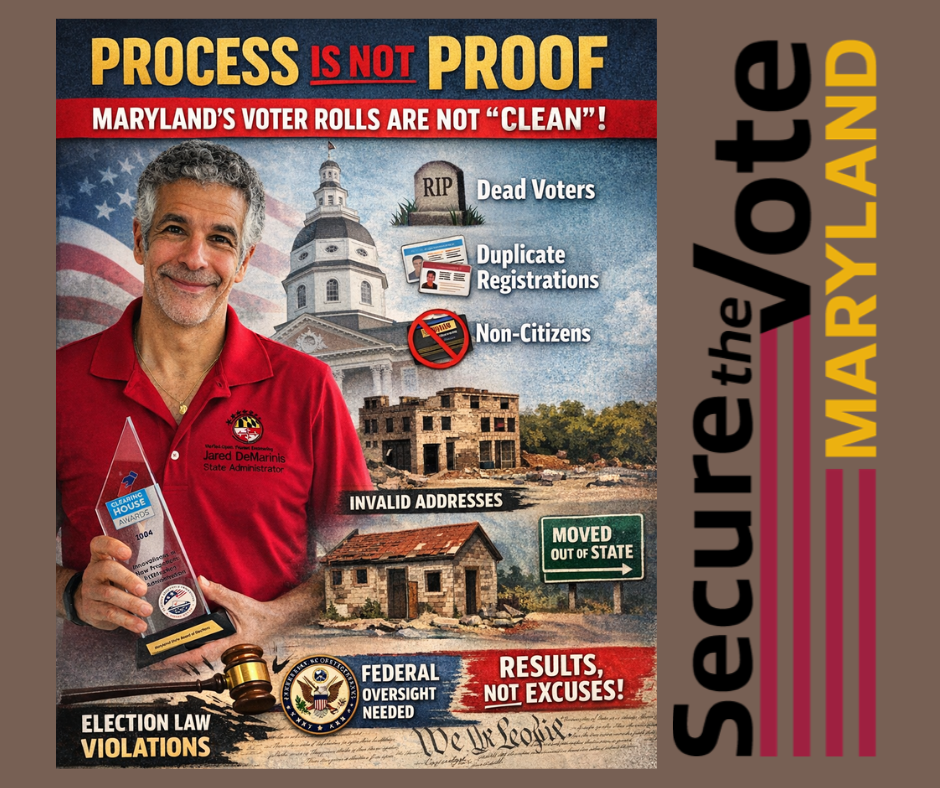
Maryland State Board of Elections Administrator Director DeMarinis continues to claim that the process his office follows proves Maryland’s voter rolls are “clean.” The facts say otherwise.
A process is only as credible as its outcomes — and Maryland’s outcomes show systemic noncompliance with election law, chronic voter-roll inflation, and thousands of ineligible voters listed as “active” for years.
The Facts (Repeated, Verified, Ignored)
We have submitted over 236,000 verified voter registration violations, including:
- deceased voters,
- duplicate registrations,
- non-citizens, (see The Curious Case of Ian Roberts)
- ineligible addresses (P.O. boxes, vacant lots, abandoned buildings),
- and voters who moved out of jurisdiction or out of state.
These are not estimates or guesses. They are easily verifiable records, repeatedly reported to election officials.
Clear Violations of Maryland Law
Across all 24 local jurisdictions, we identified deceased and duplicate voters who have remained “active” for 4+ years — a direct violation of Maryland Election Law Title 3, Subtitle 5 (§§ 3-501–3-503).
The law requires timely removal. It does not allow indefinite delay or reliance on “process” instead of compliance.
Counties With More Voters Than Eligible Citizens
Maryland now claims a highly implausible 98% statewide registration rate — and 10 counties exceed 100% registration, including Calvert, Carroll, Charles, Harford, Howard, Montgomery, Prince George’s, Queen Anne’s, Talbot, and Worcester.
That means more registered voters than eligible citizens. That is not a rounding error — it is a structural failure.
Federal Oversight Is Lawful — and Required
Director DeMarinis also claims sharing voter rolls with USCIS (U.S. Citizenship and Immigration Services) would violate state law. That claim is wrong.
- The Guaranty Clause requires the federal government to protect lawful republican elections.
- The Supremacy Clause prevents states from blocking legitimate federal enforcement.
- The Elections Clause confirms federal authority over voter systems used in federal elections.
Verifying voter eligibility is not “nonelectoral.” It is core election integrity.
Bottom Line
Director DeMarinis’s claims fail on both factual and constitutional grounds.
Worse, his refusal to comply with lawful federal requests has triggered yet another avoidable lawsuit, costing Maryland taxpayers over $75,000 to defend ideology dressed up as legal principle.
Maryland may administer elections — but it may not ignore its own laws, obstruct federal oversight, or force taxpayers to bankroll political resistance.
Process is not proof. Results matter. Accountability is required.
Something needs to be done before the mid terms. My husband lived in Carroll County until 1998. I’ll bet his name is still on the rolls there
You can always call the local BOE and check your husband’s registration! Please join us at our rally! Register here: /citizen-action/
For the past two elections, I have worked as a chief judge at a precinct close to my home in Anne Arundel County.
My job is to ensure that every eligible voter gets to vote, and that no illegible people vote.
My “other party” counterpart feels the same way (every precinct has both a Democrat and Republican chief judge), and we formally check each other’s work. The process has lots of cross-checking that make it *very* difficult to cheat– at least at the precinct level.
I can also state without compromise that so far, no dead person has shown up to vote.

Seriously, we *are* dependent on the voter registration rolls, and most people generally show their licenses when they vote (even if we don’t ask).
So my question for the “secure the vote Maryland” is this: These are serious accusations. Where is the evidence?
Why are the 236,000 verified voter registration violations not on a publicly accessible website?
Don’t give me a privacy argument unless you’ve read David Brin’s “Transparent Society.”
Full Disclosure: David and I have had numerous disagreements, but many of his ideas are gold. He points out that the main problem with privacy is that it is one-way information transfer with no accountability. He uses the example of a small town in which everyone knows everyone’s business, but everyone is generally accountable, too. Making the situation two-way solves the problem. In this case, Brin would probably say that anyone accessing the list of 236,000 verified voter registration violations should need to provide a valid driver’s license to access the database. This helps with accountability.
Thank you for your insights and feedback — and for being an election judge! We have never made the claim the system is being actively rigged from within – and we agree, the local boards, for the most part, work very hard and take their jobs very seriously. We have simply maintained, the evidence shows their systems are not working. We submit 1000s of illegal registrations monthly – all easily verified from end to end (voter name and voter id). These are primarily duplicate, dead, and moved voters but other categories like voters registered to p.o. boxes, abandoned buildings, vacant lots, empty warehouses, etc exist too. We highlight these vulnerabilities to underscore the need for voter id in Maryland. If we had voter id, these registration violations would not pose such a threat to our system. As for making these registrations public, that is not our decision. We are bound by privacy laws.
Also, why don’t you join us at our rally in Annapolis? January 27th 9am Lawyer’s Mall. Register here: /citizen-action/