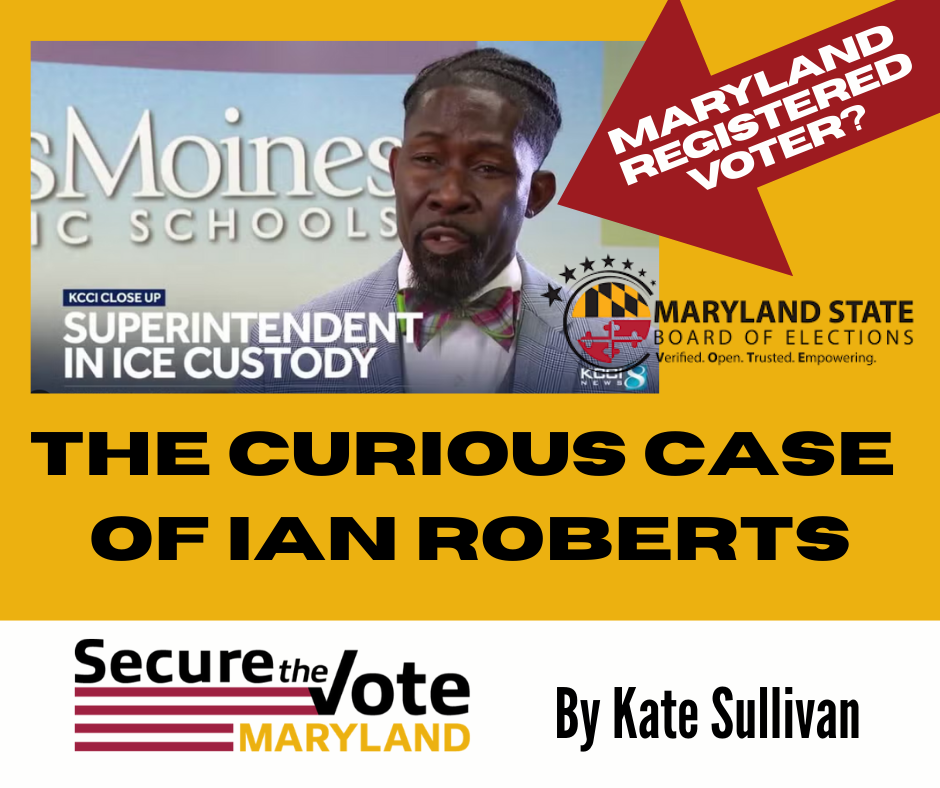
By Kate Sullivan
By any reasonable standard, election integrity depends on records that align, systems that communicate, and public agencies that can confidently account for what happened. The case of Ian Roberts raises serious questions precisely because none of those elements line up.
A Non-Citizen, Living in Iowa—Registered in Maryland
Ian Roberts is a non-citizen who resides in Iowa. Despite that, he was discovered to be registered to vote in Maryland. That fact alone warranted scrutiny. What followed was far more troubling.
Through a Public Information Act (PIA) request, SecurethevoteMD obtained and reviewed Roberts’ original voter registration documents directly from state and local election authorities. These were not secondary summaries or database extracts—they were the underlying, signed records. Those documents tell a clear story.
The Citizenship Lie—Hidden From the Public
On his voter registration application, Ian Roberts affirmatively checked the box indicating he was a U.S. citizen. This is not an ambiguity or clerical guess. It is a binary, sworn declaration. And it was false.
Even more concerning, the Maryland State Board of Elections redacted this citizenship selection when releasing the records—effectively concealing from public view the very misrepresentation that made the registration unlawful in the first place. The redaction did not protect private information; it shielded evidence of wrongdoing.
Three Ballot Requests, in Writing
The same records show that Roberts went well beyond mere registration. He personally requested mail-in ballots for three separate elections:
- The 2024 Primary Election
- The 2024 General Election
- The January 2025 Prince George’s County Special Election
These were not automatic mailings. They were explicit ballot requests, submitted on signed mail-in ballot applications. In other words, Roberts took affirmative steps—three times—to have live ballots sent to him for Maryland elections he was legally ineligible to participate in.
And Yet… No Trace in the Tracking System
Here is where the case becomes truly confounding. Despite these documented ballot requests, Ian Roberts does not appear in the Maryland State Board of Elections’ official mail-in ballot tracking system as having requested or returned ballots for any of the three elections.
The State Board asserts that Roberts “did not vote.”
But that claim rests entirely on the same mail-in tracking system that somehow failed to record:
- Three signed ballot requests
- From an ineligible, non-citizen registrant
- Whose registration should never have existed
The Logical Breakdown
This leaves the public with an unavoidable question:
If the system failed to record Ian Roberts’ documented, signed ballot requests, why should that same system be trusted to prove he did not vote?
The state’s position asks the public to accept two mutually exclusive claims:
- That Roberts’ signed mail-in ballot applications are authentic and valid records, yet
- That their complete absence from the ballot tracking system conclusively proves no ballot activity occurred
Both cannot be true.
A tracking system that cannot reliably record ballot requests cannot credibly be relied upon to disprove ballot use. When the records don’t align, the system—not the evidence—must be questioned.