By Kate Sullivan
Maryland’s election system is facing a quiet but catastrophic breakdown—one that undermines public confidence, bloats voter rolls with ineligible names, and exposes the state to fraud, administrative chaos, and national embarrassment.
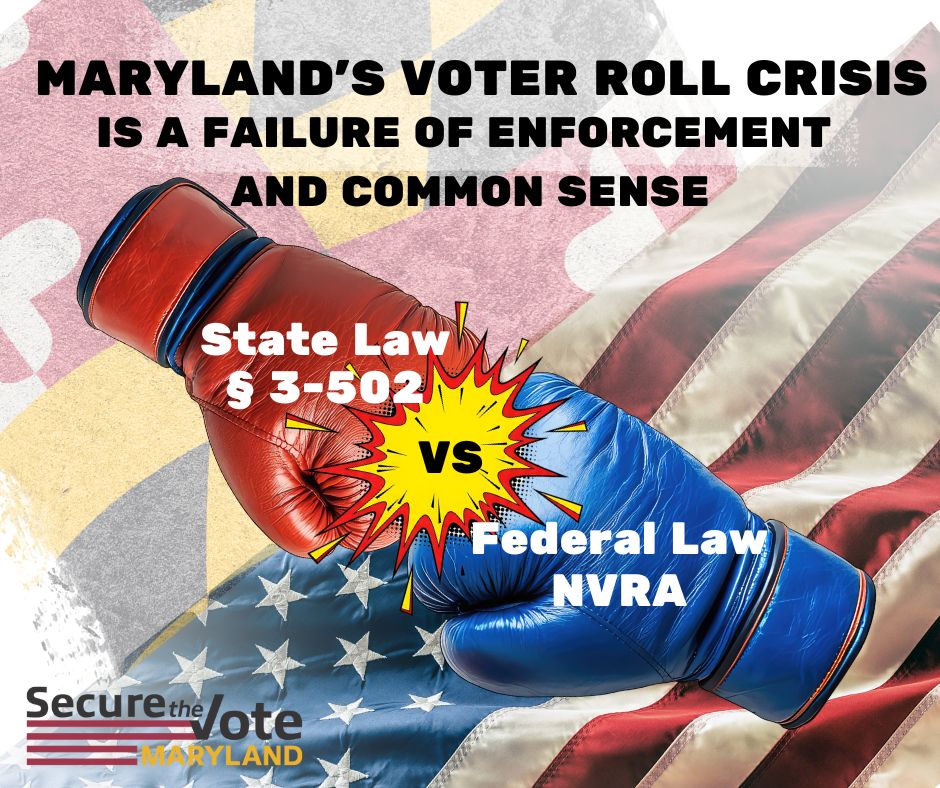
At the center of this dysfunction is the interaction between the National Voter Registration Act (NVRA) and Maryland Election Law § 3-502. The NVRA is the federal law that sets nationwide rules for voter registration and list maintenance, including strict limits on when and how states may remove voters from the rolls. Under the NVRA, a state must wait through two federal general election cycles—about four years—after a voter is placed on inactive status before that voter may be removed.
Maryland Election Law § 3-502 implements those federal requirements at the state level. It governs how Maryland flags voters for potential removal (i.e. make them “Inactive”) when officials receive information that a voter may have moved. Under § 3-502, election officials must send a confirmation notice, and only if the voter fails to respond may the voter be placed on the “inactive” list—triggering the NVRA clock that can eventually lead to removal.
On paper, that sounds reasonable. In practice, it has become a bureaucratic black hole.
Here is the single most important fact the public rarely understands:
Simply not voting—even for many years—does not allow Maryland to mark a voter “inactive.”
Under Section § 3-502, inactivity alone is legally meaningless. A voter can move out of state, never vote again, and remain listed as an active voter for decades if no returned mail is processed or no bureaucrat formally acts on the data. That is why Maryland’s rolls are riddled with long-moved voters still labeled “active.”
This is not theoretical. It is exactly what happened in the Curious Case of Ian Roberts—a non-citizen who should never have been registered in Maryland at all, yet remains listed as an active voter despite obvious red flags and prolonged inactivity.
And Ian Roberts is not alone! As of January 16, 2026, Maryland has over 960,000 “Active” voters who have not voted in more than two federal election cycles—nearly 25% of the state’s 4.3 million registered voters. While it is true many registered voters legitimately skip elections, it is still worth asking why clearly inactive voters should be labeled with an Active status, especially since the status of a voter is so central to the list maintenance process.
Bottomline: Because inactivity alone cannot trigger inactive status, removals are wholly dependent on something deeply unrealistic – ordinary citizens remembering, amidst their busy lives, to notify the State Board of Elections that they moved. Most people think about jobs, leases, schools, and utilities when they relocate—not their voter registration. Expecting them to self-report years after disengaging from politics is pure fantasy.
And to make matters worse, state officials often claim that aggressive voter roll maintenance could “disenfranchise” legitimate voters. That argument collapses under one simple fact:
Maryland already has same-day voter registration.
All reasonable people understand, any eligible voter whose registration is mistakenly removed can re-register instantly and cast a ballot the same day. So the idea that maintaining accurate rolls could somehow “prevent people from voting” is not just wrong—it is activist propaganda. Maryland does not have to choose between access and accuracy. It can—and should—have both.
We are not proposing mass purges or radical federal violations. We are proposing a modest, common-sense reform that works with the NVRA instead of against it:
After one federal election cycle of no voting activity, the state should send a clear notice reminding the voter to update their registration. If the voter does not respond within 30 days, they should be moved to inactive status. The existing NVRA two-cycle clock would then begin—exactly as federal law requires.
This would not remove anyone faster than the law allows. It would simply start the clock earlier and more reliably.
Maryland’s voter roll crisis is not a legal inevitability. It is a design failure—and a leadership failure.
Fixing it does not require new technology, federal permission, or massive spending. It requires one thing:
A State Board of Elections willing to admit that a system built around voter self-reporting and bureaucratic inertia is not serious list maintenance.
Until that happens, Maryland’s elections will continue to run on phantom voters, bureaucratic fiction, and institutional denial.
And that should outrage every citizen in this state.
Moved? Loved one die? Name change? Update your Maryland Voter Registration HERE!